Balloons, Bikes, and Brighton: Capturing the Sound of St. Bart’s
From prayers to VST - how I built the St Barts reverb plugin.
The Church of Massive Volume
St. Bartholomew’s in Brighton is an absolute beast of a building. It’s a neo-gothic giant, widely considered the tallest parish church in Britain. Because of its unique, non-standard shape, it possesses a staggering internal volume. In short: it is a reverb enthusiast’s dream and I had it in my sights for a long time.
Capturing the “Sonic Fingerprint”
Years ago, while I was teaching, I managed to convince a local priest to let me and a group of undergraduate students into the nave for an afternoon of acoustic archaeology. Our mission? To capture the “Impulse Response” (IR) of the space.
Armed with a bag of balloons, pins, a pair of stereo microphones, and a laptop, we took turns triggering the room. A popped balloon is a low-tech but highly effective way to stimulate a room’s acoustics. It provides a sharp “impulse” that covers a wide frequency range in a single point in time.
The Method: By recording this pop and using a process called convolution, you can essentially “invert” the recording. This allows you to play any clean audio, like a dry vocal or a synth, through that recorded space. The result? Instant “goth-church” atmosphere.
We did get some very confused looks from the worshippers (the priest insisted the church stay open for silent prayer), but the students were floored when we got back to the studio and heard their own tracks suddenly sounding like they were performed in a Victorian cathedral.
The Unwanted Passerby
I recently found one of the recordings from the day on an old hard drive. The initial balloon pop was perfect, but about six seconds into the decaying tail, a car or motorbike roared past the church.
The result was a textbook case of the Doppler Effect. As the vehicle sped by, it created a rasping, filtered “zing” that rose in frequency and fluctuated in volume, completely masking the natural decay of the church. It was a beautiful recording ruined by a 50cc engine.
The Restoration: Spectral Surgery
I couldn’t let that rich, early reflection go to waste, so I decided to attempt a digital restoration.
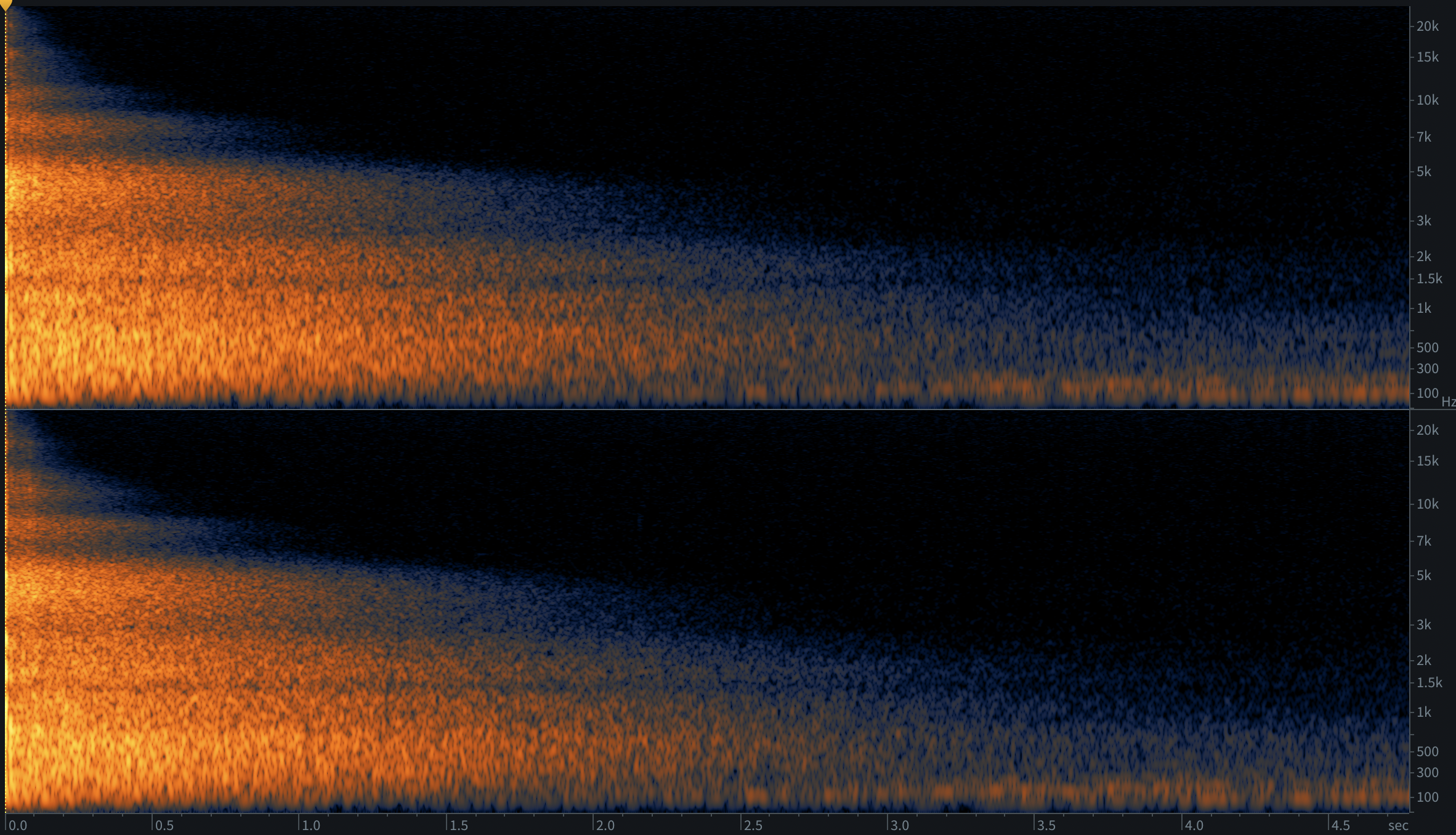
First, I used iZotope RX to manually attenuate the frequency spikes of the engine. However, cleaning out the noise left me with a “stunted” reverb. The measured RT60 (the time it takes for a sound to decay by 60dB) was only ~4.2 seconds, way too short for a space of St. Bart’s magnitude.
Before spectral repair
After spectral repair
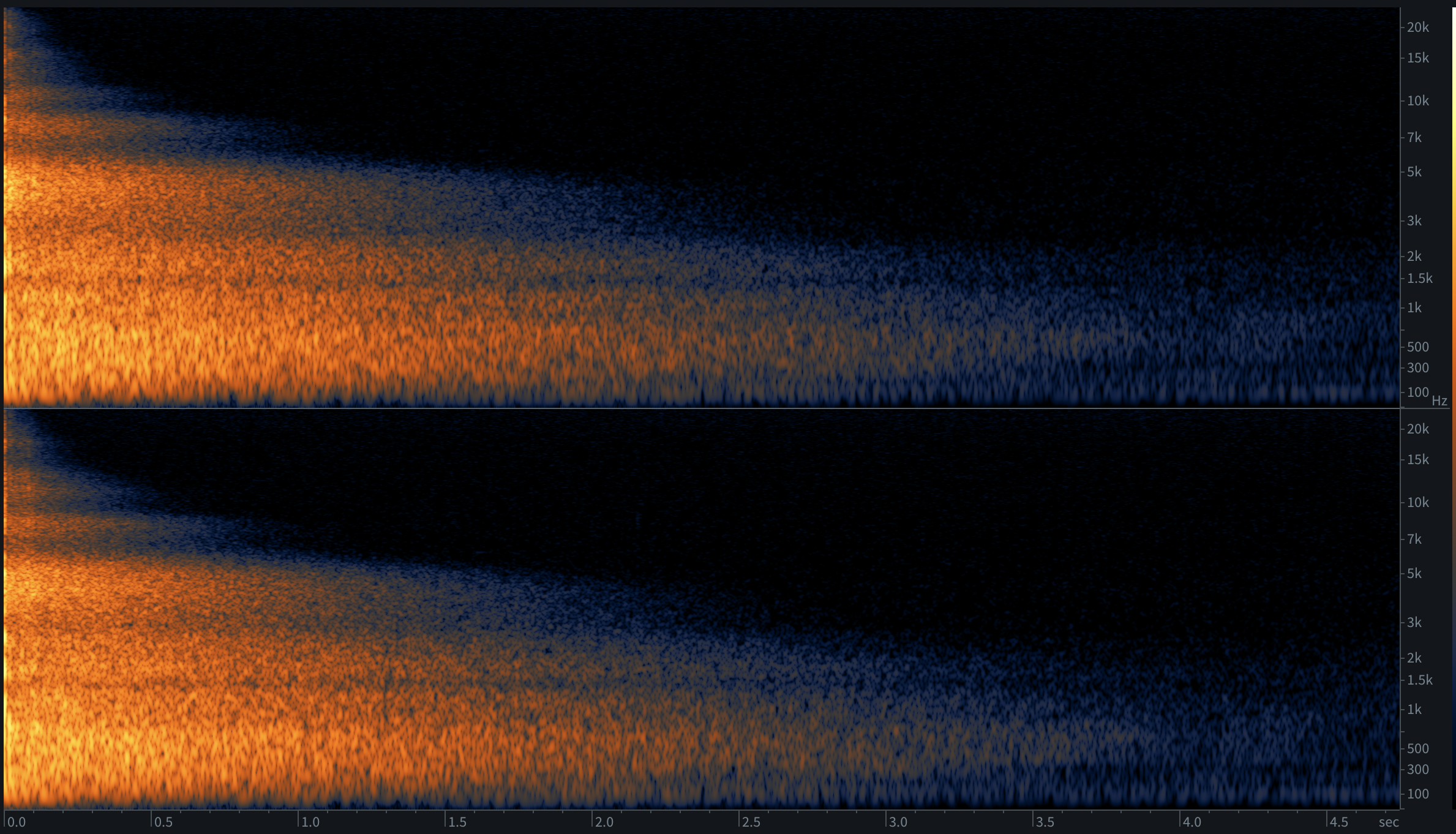
The Goal: Extend that RT 60 to a more realistic 6.5 seconds.
To bridge the gap between “real” audio and “synthetic” tail, I worked with some custom code to handle the heavy lifting. Specifically:
| Step | Process | Goal |
|---|---|---|
| 1. Decay Analysis | Measuring the slope of the cleaned audio. | Ensure the new tail matches the original’s “vibe.” |
| 2. Spectral Extension | Generating filtered noise matched to the IR’s late reflections. | Creating a seamless “ghost” of the original sound. |
| 3. Crossfade Blending | Smoothing the transition from real data to synthesized tail. | Avoiding any audible “seams” or jumps. |
| 4. Exponential Envelope | Applying a natural decay curve targeting 6.5s RT 60. | Mimicking the physics of a massive stone room. |
Building the Plugin
To actually use this restored IR, I built a plugin in C++ using a partitioned overlap-add FFT convolution algorithm. This is the gold standard for real-time reverb because it allows the computer to process long audio files without catching fire. The UI wrapper was built in JUCE.
The Technical Specs:
- FFT Size: 2 12 (4096 samples) — A sweet spot for balancing CPU load and latency.
- Partition Size: 2048 samples.
- Total IR Length: 7.5 seconds (~360,000 samples).
- Gain Normalization: The IR is peaked at -12dB. This ensures that when you crank the “Wet” knob to 100%, you don’t accidentally blow your speakers.
The final result is an IR that preserves the authentic, dark, early character of St. Bartholomew’s while offering a smooth, natural tail that (thankfully) is free of motorbikes.
Experience the St. Bart’s Sound
I’ve uploaded everything to the official project page so you can put the restoration to the test. Listen to some demos and download the Plugin to bring a piece of Brighton’s gothic history into your DAW.